Introduction
Even if you choose your hiking boots carefully, many people have experienced blisters (chafing) during hikes because they used everyday socks. In fact, many blisters can be prevented not so much by the boots themselves, but by choosing the right socks.
This article explains how to choose hiking socks by working backward from how blisters form, and specifically explains why "layering" is effective for blister prevention.
Why Do Blisters (Chafing) Form?
Blisters form when repeated friction on the skin creates a gap between the surface and deeper layers of the skin, and bodily fluid accumulates in that gap. This friction is more likely to occur when feet are sweaty and damp from sweat. Therefore, to prevent blisters, it is important to both "reduce friction" and "keep feet from getting sweaty." Understanding this mechanism reveals what to prioritize when choosing socks.
Material Choice: Cotton is Not Recommended; A Hybrid of Wool and Synthetics is Basic
When choosing materials for hiking socks, avoid cotton. Cotton absorbs sweat and is slow to dry, and its continued dampness can lead to cold feet and blisters.
A recommended option is a hybrid material that combines wool, which has excellent moisture absorption, with durable synthetic fibers. As a guideline, models with a wool content of about 50-70% are often recommended for their balance of moisture-wicking, quick-drying, and cushioning properties. Wool has the characteristic of being relatively non-sticky even when it absorbs sweat, and it also helps to suppress odor.
おすすめの登山用靴下(PR)
DANISH ENDURANCE ハイキングソックス(メリノウール・厚手クッション・3組セット) — メリノウールを使ったモデル
VAXPOT アウトドアソックス(クールマックス使用・吸汗速乾) — 化学繊維(クールマックス)を使ったモデル
Choosing Thickness and Length
The basic choice for thickness is "medium-thick," which is compatible with most hiking boots. Extremely thin socks lack sufficient cushioning, while excessively thick socks can alter the fit with your boots, so it's best to start by trying medium-thick ones.
丈については、くるぶし丈など短すぎるものは、登山靴の履き口と肌が直接擦れやすくなります。すねの下あたりまである「クルー丈」を選んでおくと、靴との摩擦から肌を守りやすくなります。
Why is "Layering" Effective for Blister Prevention?
登山用靴下の話でよく出てくるのが「重ね履き」です。薄手の靴下と厚手の靴下を2枚重ねて履く方法で、単に「暖かいから」ではなく、マメ予防の観点でも理にかなった方法です。
その理由は、摩擦が起きる場所にあります。靴下を1枚しか履いていない場合、歩行中の摩擦は「肌と靴下の間」で直接発生します。これがマメの直接的な原因です。一方、靴下を2枚重ねると、摩擦の多くは「靴下と靴下の間」で発生するようになり、肌に直接かかる摩擦が大幅に減ります。さらに、2枚の靴下の間にできる空気の層がクッションと保温の役割も果たします。
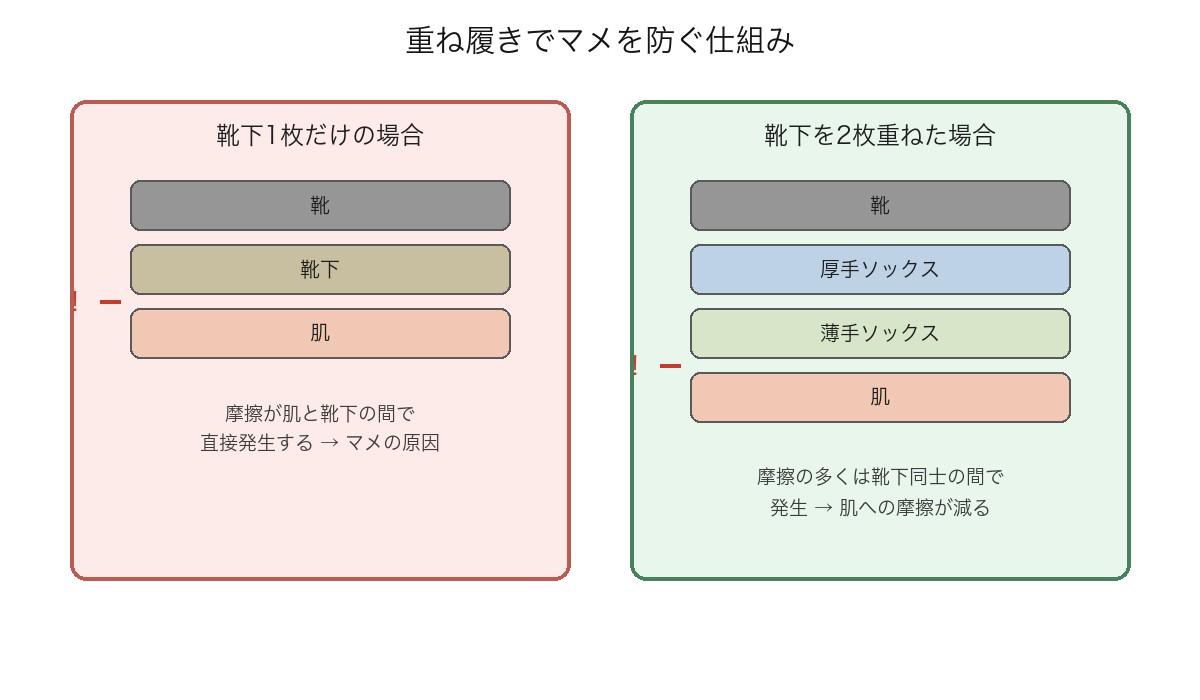
重ね履きの組み合わせとしては、薄手の五本指ソックスの上に、厚手のウール混ソックスを重ねる方法がよく紹介されています。五本指ソックスは指の一本一本を独立して包むため、指同士が直接触れ合うことによる摩擦や蒸れも防ぎやすくなります。
Benefits and Precautions of Five-Toe Socks
五本指ソックスには、指同士の摩擦・蒸れを防ぐ効果に加えて、指で踏ん張る力が伝わりやすくなり、バランスが取りやすくなるという報告もあります。一方で、普通の靴下に慣れている方が初めて使うと、履き心地の違いに違和感を覚えることがあるため、本番の登山で初めて試すのではなく、事前に普段履きなどで慣らしておくと安心です。
Summary
登山用靴下選びの基本は、マメができる仕組み(摩擦+湿気)から逆算することです。素材は綿を避けてウールと化繊のハイブリッド(ウール比率50〜70%程度)、厚さは中厚手、丈はクルー丈を基本に選びましょう。そのうえで、薄手の五本指ソックス+厚手のウール混ソックスという重ね履きを取り入れると、摩擦の発生場所を肌から靴下同士に移すことができ、マメの予防に効果的です。
登山靴自体の選び方は登山靴の選び方完全ガイドもあわせてご覧ください。