- Introduction
- The Necessity of a Mobile Battery for Mountain Climbing
- How to Choose Capacity (mAh): Guidelines Vary by Type of Climb
- Also Check Output (Wattage): Charging Speed and Compatible Devices
- An Often-Overlooked Safety Standard: Be Sure to Check for the "PSE Mark"
- Reasons and Countermeasures for Faster Battery Drain in Cold Weather
- Durability: Is it designed for outdoor use?
- Summary
Introduction
On climbs, you want to avoid your smartphone running out of battery, as it's used for checking your location on map apps, as a backup power source for your headlamp, and for communication in case of unexpected trouble. A mobile battery is essential for this, but when you try to choose one, you might wonder, "How much capacity do I need?" "Is a cheap one okay?" Many people are likely unsure.
In this article, we will explain the recommended capacity and output for choosing a mobile battery for mountain climbing, as well as the often-overlooked safety standard "PSE Mark" and measures against battery drain due to cold.
The Necessity of a Mobile Battery for Mountain Climbing
During mountain climbing, you'll use your smartphone more often than on flat ground for checking your location with GPS apps, taking photos, and communicating during your activities. If your battery runs low and you get lost or feel unwell, you could lose the very means of communication to call for help. Even for a day trip to a low mountain, a mobile battery is an item you'll want to include on your packing list.
How to Choose Capacity (mAh): Guidelines Vary by Type of Climb
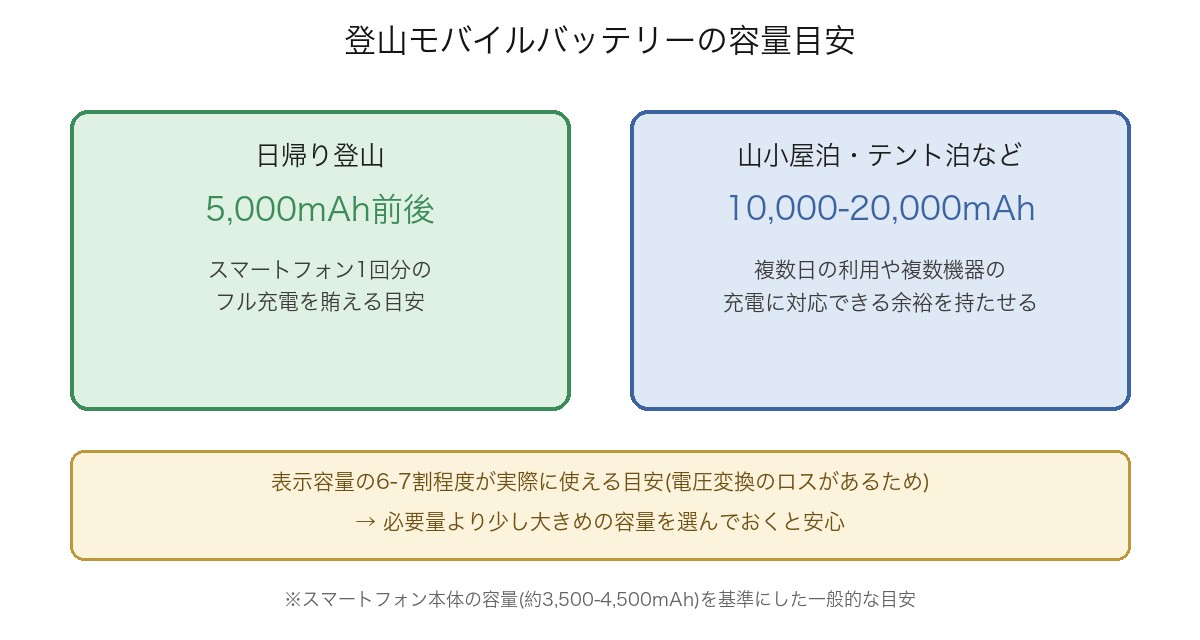
The first thing to check when choosing a mobile battery is its capacity. The battery capacity of recent smartphones is around 3,500 to 4,500mAh, so you can consider the capacity guidelines as follows:
- Day Hikes: Around 5,000mAh (enough to fully charge a smartphone once)
- Climbs with Overnight Stays (e.g., mountain huts, tent camping): Around 10,000-20,000mAh (to allow for multi-day use and charging multiple devices)
It's important to note that the displayed capacity of a mobile battery and the actual capacity that can charge smartphones, etc., are different. This is because voltage conversion losses occur when electricity is sent from the battery to the device, so the usable capacity is about 60-70% of the displayed capacity. Instead of choosing based on the 'bare minimum displayed capacity,' it's safer to choose a capacity slightly larger than what you need.
Also Check Output (Wattage): Charging Speed and Compatible Devices
Along with capacity, you'll want to check the output (wattage). Higher output models not only charge smartphones faster but also make it easier to rapidly charge other devices such as rechargeable headlamps and mobile GPS units. Models labeled as supporting USB Power Delivery (PD) offer faster charging speeds when paired with compatible devices, so if you carry multiple electronic devices, it's a good idea to compare their output values.
An Often-Overlooked Safety Standard: Be Sure to Check for the "PSE Mark"
When choosing a mobile battery, the presence of the "PSE mark" is as important as capacity and output.
Following fire accidents caused by internal short circuits during charging, the Ministry of Economy, Trade and Industry added mobile batteries (portable lithium-ion storage batteries) to the scope of regulation under the Electrical Appliances and Materials Safety Act in February 2018. As of February 1, 2019, mobile batteries without the PSE mark are prohibited from being manufactured, imported, or sold in Japan.
This means that mobile batteries sold through legitimate channels in Japan basically come with a PSE mark. However, when purchasing extremely inexpensive products through personal imports or from overseas online shopping sites, there's a risk of encountering products that do not meet this standard. Especially for mountain climbing, where batteries are used in harsh environments, being compressed in luggage and exposed to temperature differences, checking for the presence of the PSE mark is a crucial point.
おすすめのモバイルバッテリー(PR)
INIU モバイルバッテリー(10000mAh・45W急速充電・ストラップ式) — 山小屋泊・テント泊にも対応できる容量帯のモデル
Reasons and Countermeasures for Faster Battery Drain in Cold Weather
Many of you may have felt that your smartphone or mobile battery drains faster than expected while hiking. This isn't just your imagination; lithium-ion batteries experience reduced discharge efficiency at low temperatures, and their output may be limited by protective functions designed to safeguard the battery.
The following methods are suggested as countermeasures:
- Place your mobile battery and smartphone inside your backpack, close to your body or inside your luggage where the temperature is less likely to drop, rather than in an outer pocket or other area exposed to the outside air.
- Carry them in an insulated pouch or a fleece-lined bag.
- If using disposable heat packs together, choose a type that does not get too hot and do not let it come into direct contact with the battery.
In either case, the basic idea is to "not let the battery get too cold." This is especially important to keep in mind during winter or when mountaineering in high altitudes where temperatures tend to drop.
Durability: Is it designed for outdoor use?
During a climb, it's not uncommon for a mobile battery to be dropped on the ground or bumped against other gear in your backpack. Choosing a model that explicitly states shock resistance and dust/drip-proof performance will allow you to continue using it with peace of mind in such situations.
Summary
When choosing a mobile battery for mountaineering, aim for around 5,000mAh for day trips and 10,000-20,000mAh for overnight trips. Keep in mind that the actual usable capacity will be about 60-70% of the displayed capacity, so allow for some extra. In addition to output (wattage) and durability, don't forget to check for the presence of the PSE mark as a safety standard. Extremely cheap products may include those that do not meet this standard. Also, considering that batteries deplete faster in the cold, be mindful of how you carry it to keep it warm.
For information on how to prepare your overall gear, see the Guide to Necessary Items for Beginner Hikers, and for how to choose a headlamp, see the Guide to Choosing a Headlamp for Hiking.