- Introduction
- For the first 20-30 minutes, deliberately walk slowly.
- Pace Management Guideline: "Able to converse" | "Half the speed of normal walking"
- Break Frequency: Every 30 minutes at the start, then 10 minutes every hour once accustomed.
- How to Think About Course Times: For beginners, aim for 1.3 times the standard course time.
- Posture and Footwork
- Downhill Tips: How to walk to reduce strain on your knees
- Summary
Introduction
Once you've chosen a mountain to climb and gathered your gear, the next thing you're probably wondering about is "How can I actually walk without getting tired?" It's often said, "Just walk slowly," but many people set out without knowing specifically at what pace or how often they should rest.
In this article, we summarize and explain the basics for beginners to walk safely and without fatigue, from how to set the pace at the beginning of the climb, to break frequency, how to think about course times, and how to walk downhill, which is often overlooked.
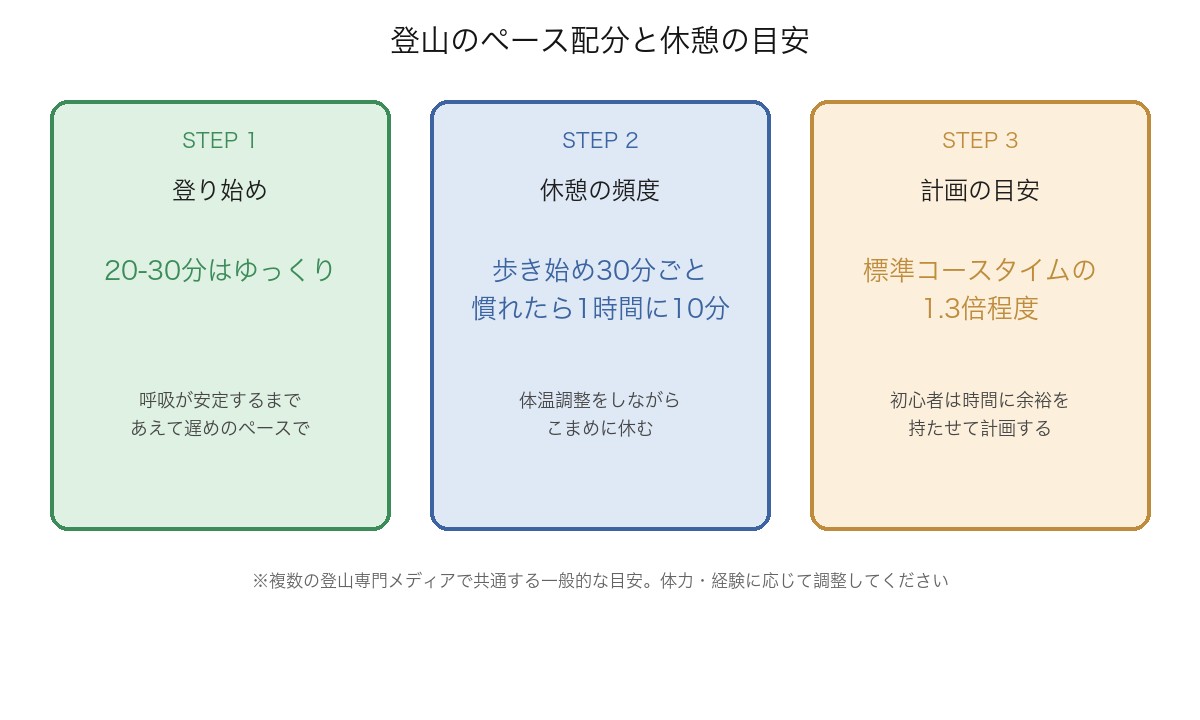
For the first 20-30 minutes, deliberately walk slowly.
If you try to find your own pace right after you start walking, you'll likely get out of breath and expend a lot of energy. It is recommended to deliberately walk slowly for the first 20-30 minutes, at a pace that feels almost too slow, to stabilize your breathing. After about 30 minutes, once your breathing has settled, gradually start walking at your own pace.
Pace Management Guideline: "Able to converse" | "Half the speed of normal walking"
The basic pace while walking is to maintain a speed that allows you to converse without getting out of breath, and to keep a consistent pace. As a guideline, walking at about half the speed you normally walk in town or on flat ground is considered a good pace. It often feels "slower than I expected," but this is actually a good pace for walking for long periods.
Break Frequency: Every 30 minutes at the start, then 10 minutes every hour once accustomed.
How you take breaks is also an important point for preventing fatigue. Since your body is not yet accustomed to hiking at the beginning, it's good to take short breaks every 30 minutes to adjust your clothing and body temperature as you walk. Once your body gets used to it, taking about 10 minutes of rest for every hour of walking is a good guideline.
How to Think About Course Times: For beginners, aim for 1.3 times the standard course time.
The "standard course time" displayed on hiking maps and apps is the estimated time based on people who are somewhat accustomed to hiking. For beginners, it's advisable to plan for about 1.3 times the standard course time, allowing for frequent breaks, so you can hike at a relaxed pace without feeling rushed. Let's plan with extra time for the course, considering the concept of physical exertion introduced in the How to Choose a Mountain Guide.
Posture and Footwork
When ascending, try to maintain an upright posture without leaning too far forward. When taking steps, instead of just pushing off with your toes, walk as if placing your entire sole on the ground. This prevents excessive strain on specific muscles like your calves. On steep ascents, instead of climbing straight up, walk in a zigzag pattern (switchbacks) to reduce the elevation gain per step and conserve energy.
Downhill Tips: How to walk to reduce strain on your knees
In hiking, trouble with your legs and hips actually tends to occur more on descents than ascents. One reason for easily injuring your knees on descents is the "thudding" walking style that creates a large impact on landing. When descending, lightly bend your knees to absorb the impact like a cushion, and consciously keep your center of gravity over your body. This will reduce the strain on your knees. Also, avoid trying to cover large steps in one go; taking smaller steps and choosing routes with fewer large drops are key points to prevent pain in your knees and the soles of your feet.
Using trekking poles can help reduce the impact on your knees, especially during descents, by distributing the landing shock to your arms. Consider using them for courses that are expected to have long descents.
Summary
The key to walking without getting tired is to deliberately walk slowly for the first 20-30 minutes of the ascent, maintain a steady pace that allows for conversation, and take breaks every 30 minutes when you start, or for 10 minutes every hour once you're accustomed to it. When planning, aiming for about 1.3 times the standard course time will allow you to hike with plenty of leeway. And on descents, which are often overlooked, bending your knees slightly to avoid landing heavily and choosing routes with fewer large drops are key points to prevent leg and hip trouble.
For information on how to prepare your gear, please see the What Beginners Need for Hiking Guide, and for how to choose a mountain that suits you, see the How Beginners Can Choose a Mountain Guide.