Introduction
Within the basic "layering" system for hiking attire, one aspect that beginners often find surprisingly difficult to choose is the "mid-layer." With many types like fleece, synthetic insulation, and down, many people may wonder which one to buy.
In this article, after organizing the characteristics of each, we will specifically explain how to use mid-layers differently from the perspective of "whether you wear it while active or during rests/stoppages."
The Role of the Mid-Layer
The mid-layer is an intermediate layer worn between the base layer, which wicks away sweat, and the outer layer (rainwear), which protects you from wind and rain. Its main role is insulation, and you adjust your body temperature by putting it on and taking it off according to the temperature and your activity level.
Fleece: A classic choice that's easy to wear continuously while active
Fleece is a material that ensures warmth by raising the nap of polyester fibers and trapping a lot of air between them. It has high breathability and is less likely to cause stuffiness even when you sweat, making it easy to wear continuously while active.
On the other hand, it has the weakness of being easily penetrated by wind. In windy locations such as ridgelines, it is necessary to layer it with an outer shell like rainwear to block the wind. If you are purchasing your first piece, a thin to medium-weight fleece that is versatile for low mountains from spring to autumn and high mountains in summer is a basic choice.
Synthetic Insulation: Warmth wear that's easy to use even during active periods when you sweat
Synthetic insulation is a jacket filled with synthetic fiber batting. Because it has excellent breathability and moisture-wicking properties, it can be used relatively comfortably even during active periods when you sweat a lot. Many have a smooth outer surface and are characterized by being easy to layer with outer shells like rainwear.
The big advantage is that even if you get wet in the rain, the insulation doesn't drop as much as down, and it dries quickly. In mountains where the weather can change easily, this "resistance to getting wet" characteristic provides peace of mind.
Down: Lightweight and highly warm, but vulnerable to moisture
The biggest advantage of down is that for the same level of insulation, it is lighter and packs smaller than fleece or synthetic insulation. It's suitable for uses like quickly taking it out of your pack and putting it on during breaks.
However, down has a major weakness. When it gets wet, the down clumps together, losing its ability to trap air and significantly reducing its insulation. Therefore, it's not suitable for high-exertion activities where you sweat a lot, but rather for breaks or stationary periods (like during the night in mountain huts or tent camping) when you don't sweat much.
Decision Flow for Usage
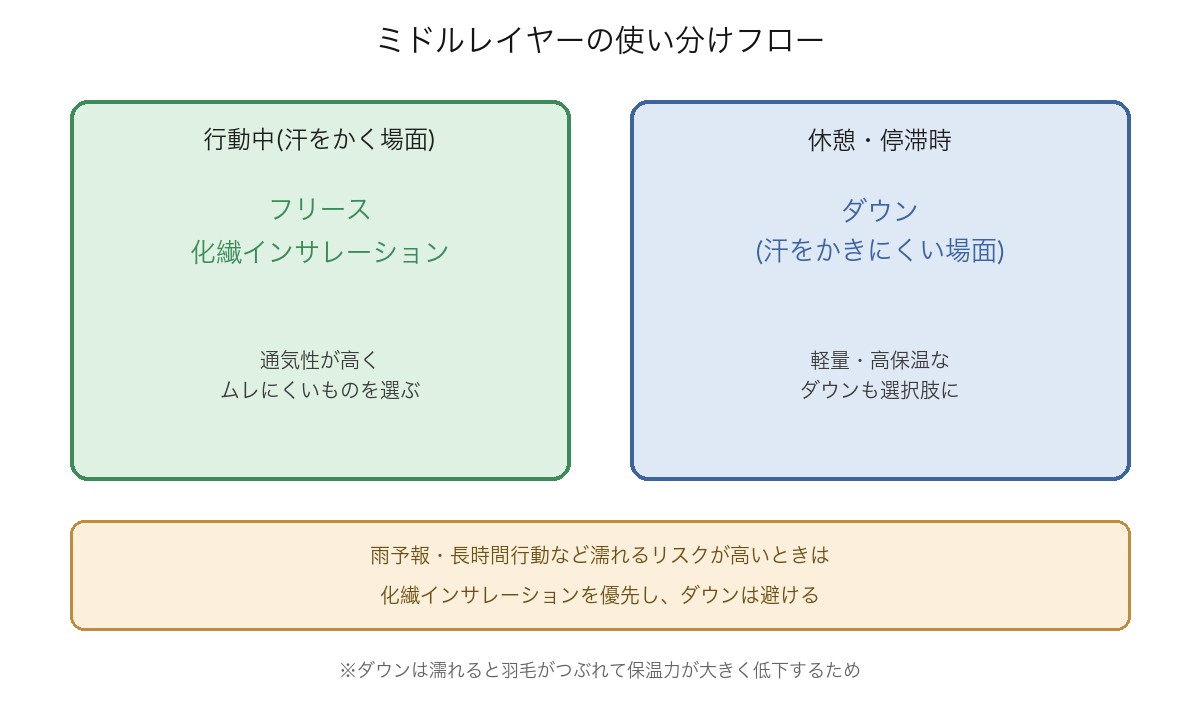
Considering the characteristics of these three types, the following decision flow makes it easier to choose.
- Wearing during activity or during breaks/stationary periods: For activities where you sweat, highly breathable fleece or synthetic insulation is suitable. For breaks or stationary periods when you don't sweat and aren't moving, lightweight and highly insulating down is also an option.
- High risk of getting wet?: If rain is forecast, or if you'll be active for a long time and are likely to get wet from sweat, it's safer to prioritize water-resistant synthetic insulation and avoid down.
If you're building your first set of gear, a good approach is to start with fleece as a basic item, as it's highly breathable and easy to use during activities. Then, for colder seasons or longer trips with extended breaks, you can add synthetic insulation or down. This is a manageable way to build your gear.
Summary
If you're unsure about choosing a mid-layer, consider it along two axes: "Will I wear it during activity or during breaks/stationary periods?" and "Is there a high risk of getting wet?" By understanding the characteristics of fleece and synthetic insulation (highly breathable and good for activity), and down (lightweight, highly insulating but vulnerable to moisture), you can learn to use them appropriately for different situations.
For the basics of dressing (layering) and how to prepare your overall gear, please see the Guide to What Beginners Need for Hiking. For rain and moisture protection (outerwear), please see the Guide to Choosing Hiking Rainwear.