Introduction
Introduction You've heard that climbing gloves are necessary, but many people may not know if the work gloves they have at home are sufficient, or what criteria to use for selection. This article, based on information supervised by an international mountain physician, explains the mechanisms of heat loss from the body and why work gloves are not suitable, and then explains the roles and selection of climbing gloves.
The 3 Roles of Gloves
Climbing gloves broadly have three roles: "protection," "cold protection," and "waterproofing."
- **Protection**: Prevents lacerations when falling and putting your hands out on chains or rocky terrain, prevents puncture wounds from branches and thorns, and improves grip.
- **Cold Protection**: Prevents coldness in the extremities and maintains finger dexterity during activity.
- **Waterproofing**: Prevents body temperature loss due to hands getting wet from rain or snow.
Why Do Hands Get Cold Easily?
When the skin senses cold, peripheral blood vessels constrict via the autonomic nervous system (sympathetic nervous system). This is a bodily defense mechanism to protect the temperature of the core body (the torso where the internal organs are located). As a result, blood flow to the extremities, such as the hands and feet, is sacrificed, and they cool down preferentially. If you feel your fingertips becoming numb during activity, you can interpret it as a sign that your body is beginning to sacrifice your limbs to protect your core.
The Dangers of "Wetness" Seen Through the 4 Mechanisms of Heat Loss
According to information supervised by Dr. Tomohide Ichikawa, an international mountain physician (Climber's Clinic, Matsumoto Kyoritsu Hospital), the pathways through which heat is lost from the body can be categorized into the following four types:
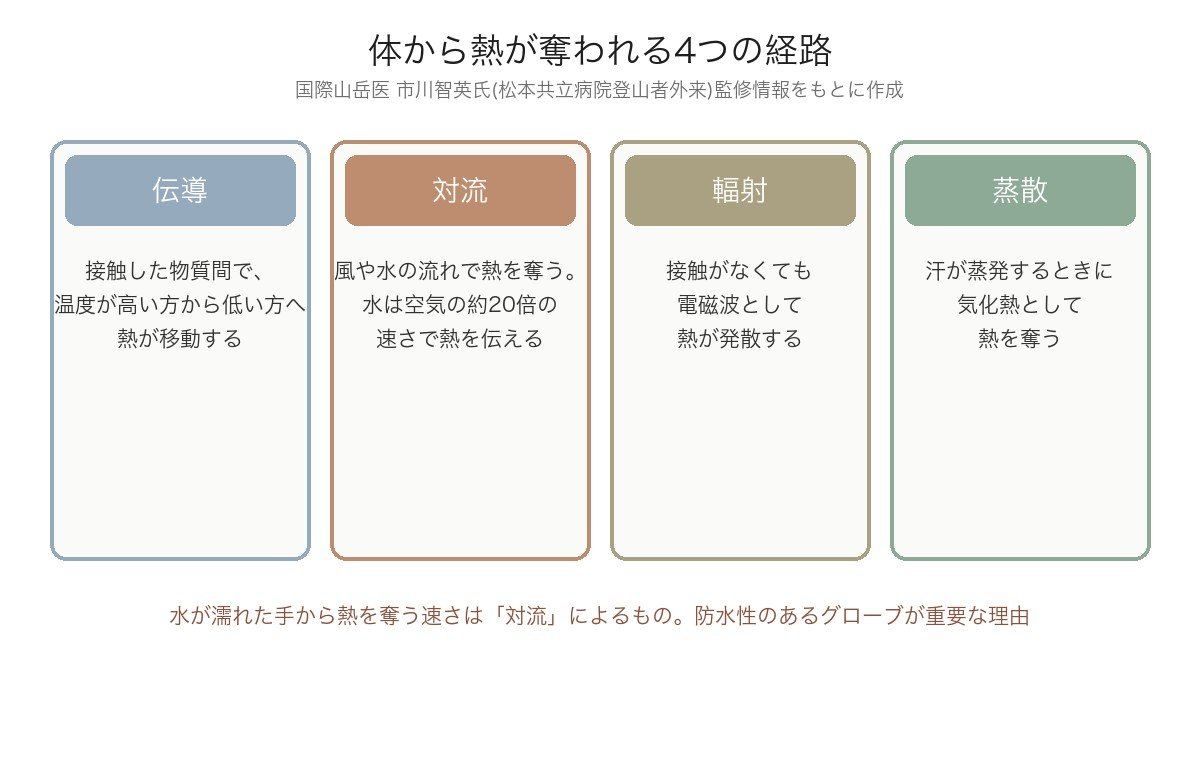
- **Conduction**: The phenomenon where heat transfers from a higher temperature object to a lower temperature object through direct contact with substances.
- **Convection**: The phenomenon where heat is lost due to the flow of air or water. Water is said to conduct heat about 20 times faster than air.
- **Radiation**: The phenomenon where heat is emitted as electromagnetic waves, even without direct contact.
- **Evaporation**: The phenomenon where heat is lost as latent heat when sweat evaporates.
この中で注目したいのが「対流」です。水は空気の約20倍の速さで熱を伝えるとされているため、手が濡れた状態は、乾いた状態に比べてはるかに早く体温を奪われてしまいます。ベースレイヤーの選び方で解説した「コットンが登山用インナーに向かない理由」も、まさにこの「濡れると熱を奪われやすい」という同じロジックです。軍手は綿素材でできていることが多く、濡れると乾きにくいため、登山用グローブとしては不向きとされています。
How to Use Gloves Differently Depending on the Season
- 夏山・低山: 汗をかきやすいため、通気性のよい薄手のグローブや、日焼け防止を兼ねた手の甲を覆うタイプ
- 秋・気温が下がる場面: フリースなど防寒性のあるインナーグローブ
- 雨天時・積雪期: レインウェアやゲイターと同じように、防水性のあるシェルグローブを選ぶ
行動中に手が濡れたり冷えたりした場合に備えて、予備のインナーグローブを1組持っておくと安心です。
おすすめの登山用グローブ(PR)
ミレー(Millet) QD TREK GLOVE — 保護・防寒を兼ねたトレッキング向けグローブ
ショーワグローブ TEMRES 04advance(透湿防水レイングローブ) — 雨天時・積雪期向けの防水シェルグローブ
Summary
登山用グローブは、岩場での怪我防止という「保護」の役割に加え、水が空気の約20倍の速さで熱を奪うという仕組みを踏まえた「防寒」「防水」の役割も担っています。軍手は綿素材で濡れると乾きにくいため、コットンのベースレイヤーが向かない理由と同じ理由で登山には不向きです。季節や天候に応じて、防水性・防寒性を備えた登山用グローブを選びましょう。