Introduction
"Cotton T-shirts are not recommended for hiking" is often said, but many people may not know why they are not suitable, or how to choose between synthetic fibers and merino wool. The base layer (innerwear that directly touches the skin) is the foundation of the three-layer structure (layering) of hiking, along with mid-layers and rainwear, and is crucial for preventing sweat chilling.
This article explains the mechanism behind why cotton is considered dangerous, the characteristics of synthetic fibers and merino wool, and how to use them differently depending on the season and purpose, based on information supervised by Yohei Ueda, a certified hiking guide from the Japan Mountain Guides Association.
Why Cotton Innerwear is Not Recommended for Hiking
Cotton is a natural material that feels good against the skin and has good moisture absorption, but it also has the property of **retaining water and being difficult to dry**. As a result, it remains wet for a long time after absorbing sweat.
When wet clothing dries, a phenomenon called "evaporative cooling" occurs, where the surrounding heat is absorbed as moisture changes from liquid to gas. Wearing wet clothing in the wind causes body heat to be rapidly lost due to this evaporative cooling. This is "sweat chilling," and in some environments, it can lead to hypothermia. Even in summer mountains, temperatures can drop easily at high altitudes or on ridgelines, so it's important to be aware that the risk is greater than you might think.
Characteristics of Synthetic Fibers and Merino Wool
Instead of cotton, synthetic fibers (such as polyester) and merino wool are used as innerwear for hiking. Each has different strengths, so it's best to understand them as "trade-offs" rather than asking "which is superior?"
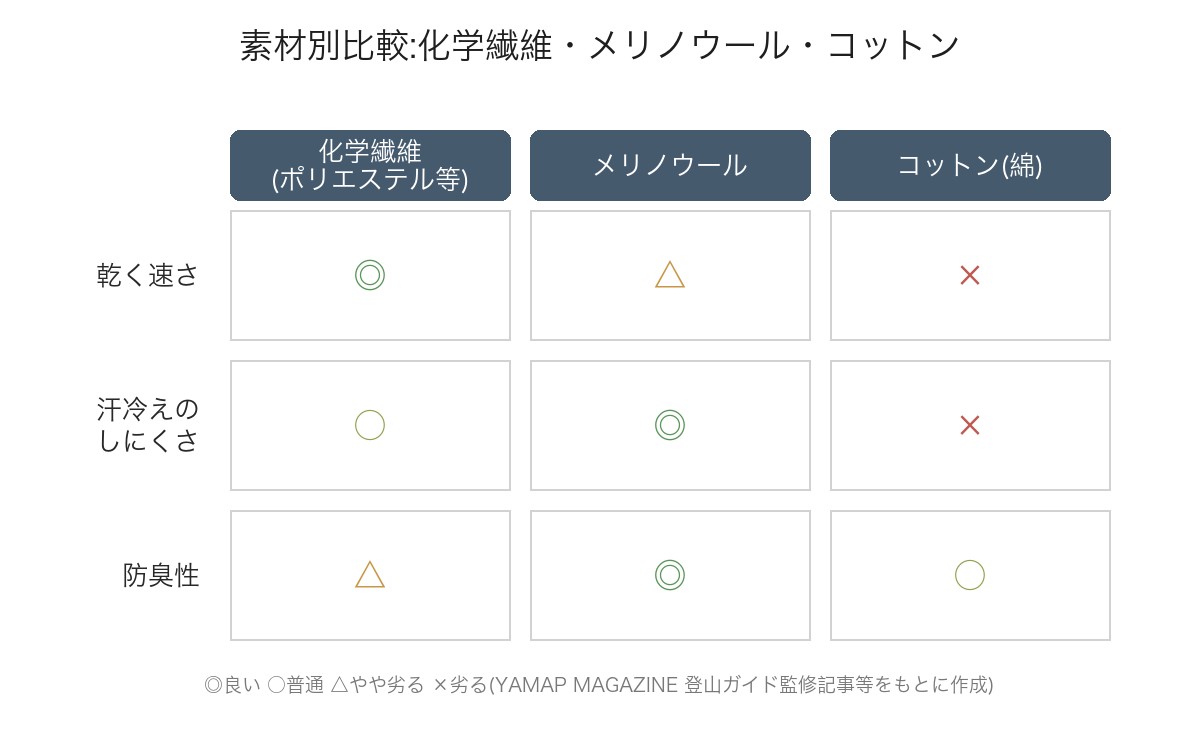
Synthetic Fibers (Polyester, etc.): Dries extremely quickly
It has the property of quickly releasing moisture from the skin's surface to the fiber's surface, making it excellent for quick drying. It is also lightweight, durable, and a benefit is that it can be obtained at a relatively low price. On the other hand, the rapid drying process can easily lead to a drop in body temperature due to evaporative cooling, and you may feel cold sweat in situations like windy ridgelines. Another disadvantage is that synthetic fibers tend to breed bacteria easily, which can cause odor.
Merino Wool: Dries slowly and is less prone to sweat chilling
While it has excellent moisture-wicking properties, it also retains warmth when wet, so it is said to cause less cold sweat compared to synthetic fibers. Furthermore, it has natural antibacterial properties, making it highly odor-resistant, which is another major feature. It is also suitable if you want to reduce the number of changes of clothes during a multi-day trek. The disadvantages are that it takes longer to dry compared to synthetic fibers and the price is higher.
Blended Type: Balanced
Blended types, which mix synthetic fibers and merino wool, offer an excellent balance of quick-drying and warmth-retaining properties. It is worth considering as an option when you cannot decide on one property over the other.
おすすめのベースレイヤー(PR)
ミレー(Millet) FLAG TS(半袖ベースレイヤー) — 速乾性を重視した化学繊維モデル
Kyowooool 100%メリノウールTシャツ(半袖ベースレイヤー) — 汗冷え・防臭を重視したメリノウールモデル
Guidelines for Use by Season and Purpose
- Summer day hikes / Situations where you sweat a lot: Choose synthetic fibers for their quick-drying and UV-cut functions.
- Situations where temperatures drop, multi-day treks where you want to avoid the risk of cold sweat, autumn/winter season: Choose mid-weight, brushed merino wool or blended types.
This is only a general guideline, and the optimal choice will vary depending on individual perspiration levels and the day's temperature. If you are concerned, carrying a spare base layer to change into during activity is also an option.
Summary
Cotton is not suitable for hiking base layers because there is a clear mechanism: "high water retention and slow drying → body temperature is lost due to evaporative cooling → risk of cold sweat/hypothermia." Synthetic fibers excel at quick drying but are inferior in terms of cold sweat and odor, while merino wool is less prone to cold sweat and has high odor resistance, but is slow to dry and expensive. Choose according to the season and itinerary.
Along with how to choose a mid-layer and how to choose rainwear, please choose materials suitable for each of the three layers—base, mid, and outer—to enjoy comfortable hiking. Also, see physical training to prepare for situations where perspiration increases.