- Introduction
- First, basic measures to avoid encountering bears
- August 2026: Ministry of the Environment publishes "Recommended Requirements for the Performance of Bear Deterrent Sprays"
- How to Choose a Bear Deterrent Spray Based on Recommended Requirements
- Carrying Method: Not allowed inside a backpack
- Points to Note When Using
- What to Do If You Encounter a Bear
- Summary
Introduction
When it comes to bear safety during hiking, many people may have the impression that "bear bells are enough." However, in fiscal year 2025 (Reiwa 7), there was a large number of bear sightings, mainly in eastern Japan, and human casualties reached a record high. In response to this situation, on August 25, 2026, the Ministry of the Environment released the "Recommended Requirements for the Performance of Bear Deterrent Sprays" for the first time, and the Consumer Affairs Agency and the National Consumer Affairs Center also issued warnings.
In this article, in addition to the basic concept of avoiding bear encounters, we will explain in detail how to choose, carry, and use bear deterrent sprays based on these recommended requirements recently published by the Ministry of the Environment.
First, basic measures to avoid encountering bears
Bears have excellent hearing and sense of smell, so the basic principle of avoiding encounters is to make them aware of human presence through sound or smell, and have them avoid people. Bear bells are a prime example of this, and the sound of brass bear bells is said to reach tens of meters away. However, it has also been pointed out that their effectiveness may be limited on windy days or in places with loud river sounds. It is important not to rely on a single measure, but to combine multiple measures, such as speaking out at blind curves and making noise with a radio during breaks, in addition to using bells.
August 2026: Ministry of the Environment publishes "Recommended Requirements for the Performance of Bear Deterrent Sprays"
Previously, there were no official standards or performance criteria for products called "bear deterrent sprays" in Japan. As a result, investigations by the Ministry of the Environment, the Consumer Affairs Agency, and the National Consumer Affairs Center confirmed that products with questionable effectiveness, such as tear gas sprays for humans marketed as bear deterrents, and counterfeit products with labels closely resembling genuine overseas products, were being distributed in the market.
In response to these circumstances and the increase in bear encounters and human injuries in fiscal year 2025, the Ministry of the Environment announced the "Recommended Requirements for Bear Repellent Sprays" on August 25, 2026, the first of its kind in Japan. Concurrently, the Consumer Affairs Agency and the National Consumer Affairs Center have also released cautionary materials regarding purchase, storage, and use.
Please note that these recommended requirements are not legally binding, nor do they uniformly negate the effectiveness of products that do not meet the requirements. However, they serve as a highly valuable objective standard for selecting products.
How to Choose a Bear Deterrent Spray Based on Recommended Requirements
We will organize the key points of the recommended requirements presented in the Ministry of the Environment's materials as criteria for selection.
| Item | Content of Recommended Requirements |
|---|---|
| Active Ingredient Concentration | Capsaicin and related capsaicinoid concentration (CRC concentration) should be approximately 1.0-2.0%, displayed to the first decimal place. |
| Spray Distance | Approximately 7.5m or more under normal temperature and windless conditions. |
| Spray Duration | Continuous spray should be possible for approximately 6 seconds or more. |
| Spray Pattern | A "mist-like" cone-shaped spray that spreads out and does not require precise aiming (a "streaming" type that shoots in a straight line is not recommended). |
| Safety Mechanism | A structure that is not easily disengaged by vibrations during walking, etc., but can be smoothly released and sprayed even by touch in an emergency. |
| Expiration Date | An expiration date based on the manufacturer's verification data should be displayed. |
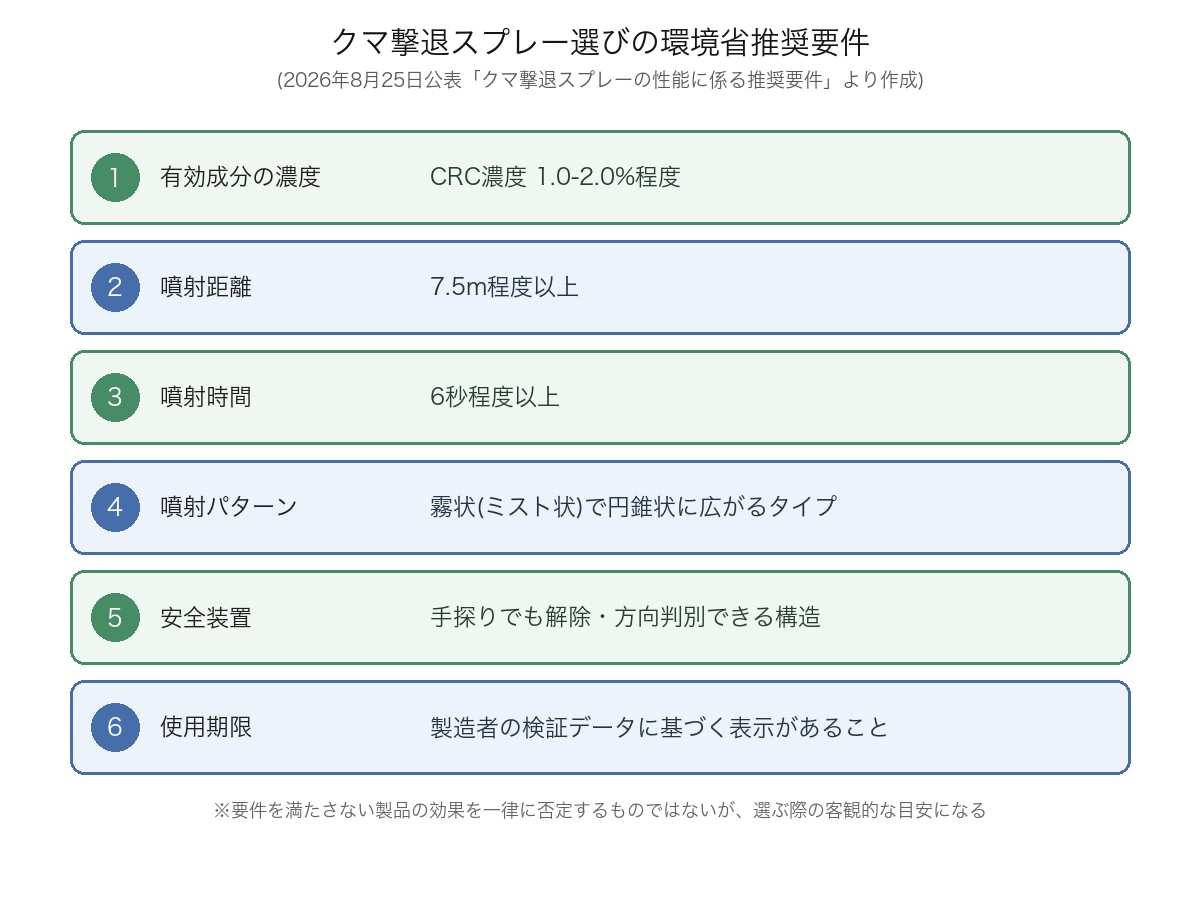
Spray distance is particularly important. Bears can run at speeds of up to 40 km/h (over 11 m/s), and if a bear charges from a distance of 30m, there is less than 3 seconds to prepare the spray. Products with short spray distances carry a higher risk of not reaching the bear due to wind or other factors, or if they do reach, the distance is too close to stop the charge. For these reasons, a spray distance of 7.5m or more has been set as a recommended requirement.
Furthermore, repurposing tear gas sprays for human use for bear defense is absolutely not recommended, both from the perspective of safety to humans and effectiveness against bears. The prerequisite for purchase is to choose a product clearly labeled as "for bears" or "for repelling bears."
Carrying Method: Not allowed inside a backpack
A bear repellent spray is useless if it cannot be used immediately in an emergency. The Ministry of the Environment's materials explicitly state that carrying methods such as storing it in a backpack or side pocket are not recommended, as it would be too late to retrieve it.
It is strongly recommended to use a dedicated carrying case that can be securely attached to your waist or chest using the belt loops of your pants or the shoulder straps of your backpack, keeping it easily accessible at all times. Avoid using substitutes like commercially available pet bottle holders, as they can get caught on branches and fall off, or dislodge the safety mechanism and cause accidental discharge.
Points to Note When Using
Based on cautionary materials from the Consumer Affairs Agency and the Ministry of the Environment, we will summarize the key points to keep in mind when using bear spray.
- If you are at a distance from the bear, the basic approach is to leave the area quietly without spraying. The spray is an emergency defensive measure against approaching or charging bears and is not intended for use as a deterrent.
- When using the spray, as a general rule, spray from upwind of the bear, aiming for the bear's face (eyes and nose).
- It is recommended to practice visualizing the distance to the bear beforehand and to confirm the operating method with a practice spray (however, test firing with the actual product is not recommended due to the risk of accidental discharge or reduced gas pressure).
- Pre-spraying around tents or other areas for repellent purposes is not recommended, as the smell may actually stimulate the bear's curiosity and attract it.
- Do not remove the safety device unless necessary, and do not store it in places that get hot.
- Cannot be brought aboard aircraft.
What to Do If You Encounter a Bear
The most important thing when encountering a bear is to remain calm and respond appropriately. If there is sufficient distance between you and the bear, quietly observe and leave the area. If the bear approaches, calmly make your presence known by speaking. Avoid actions such as running away or shouting loudly, as these can agitate the bear. Bear deterrent spray should be used as a last resort if the bear approaches or charges at close range.
Summary
Bear countermeasures require both measures to avoid encounters, such as using bear bells, and preparations for the unlikely event of a close-range encounter. The recommended specifications (CRC concentration 1.0-2.0%, spray distance of 7.5m or more, spray duration of 6 seconds or more, fog-like spray pattern, reliable safety device) published by the Ministry of the Environment in August 2026 serve as a reliable guideline for choosing bear deterrent spray. Also, remember to carry it attached to your waist or chest so you can use it immediately in an emergency, and to practice visualizing the situation beforehand.
For general safety measures for mountain climbing, please see the Complete Guide to Mountain Climbing Safety Measures, and for planning your climb, such as rules for contacting others after descending, please see the Guide to Writing Your Climbing Plan (Mountain Climbing Notification).