Introduction
Rainwear is the last of the "holy trinity" of essential gear you'll want to prioritize when starting hiking. Just like hiking boots and backpacks, with terms like water pressure resistance, breathability, materials, and price range, it's easy to get lost on what criteria to use for selection.
In this article, we will carefully explain the concepts of water pressure resistance and breathability you should consider when choosing rainwear, what changes depending on the price range, and the "care methods when water repellency fades," for which there is surprisingly little information.
What are "Water Pressure Resistance" and "Breathability" Needed for Rainwear?
"Water pressure resistance" and "breathability," which are often seen on rainwear spec sheets, are both important values for continuing your hike comfortably.
Water Pressure Resistance Standards
Water pressure resistance is a value indicating how much water pressure the material can withstand without letting water through. For hiking, a rating of 20,000mm or higher is considered safe for heavy rain and prolonged use.
| Water Pressure Resistance Standards | Expected Weather Conditions |
|---|---|
| Several hundred to approx. 2,000mm | Light rain/stroll |
| Approx. 10,000mm | Heavy rain |
| 20,000mm or higher | Heavy rain and prolonged wind/rain expected during hiking |
Breathability Standards
Breathability is a value indicating how well moisture vapor from sweat inside can escape to the outside. For hiking, a standard of 10,000g/㎡・24h or higher is generally recommended. If breathability is low, even if it blocks rain, the inside can become stuffy with sweat, which can lead to your body getting cold.
Types of "Gore-Tex," a Representative Waterproof Breathable Material
The most well-known material for rainwear is "Gore-Tex." There are the following grades depending on the application:
- Gore-Tex Pro: Highly durable and waterproof, for serious mountaineering.
- GORE-TEX Active: Lightweight and highly breathable, ideal for high-intensity activities like mountaineering where you sweat a lot.
- GORE-TEX Paclite: Lightweight and compact, suitable for those who want to pack light.
In addition to these, there are proprietary waterproof-breathable materials from various manufacturers (such as DRY-TEC) that offer performance equal to or exceeding GORE-TEX. Instead of focusing solely on the material name, checking the water pressure resistance and breathability ratings will help you avoid making a poor choice.
Differences in Rainwear by Price Range
You're probably also wondering, "What price range should I aim for?" (Prices vary by brand and model, so please use these as a general guide).
| Price Range | Features |
|---|---|
| Around ¥8,000–¥10,000 | Entry-level models. Many meet the minimum standards for water pressure resistance and breathability for mountain climbing, but they tend to have thinner fabric and less durability. |
| Around ¥15,000–¥20,000 | Mainly models that use major waterproof-breathable materials like GORE-TEX. Suitable for a wide range of activities, from day trips to overnight stays in mountain huts. |
| ¥20,000–¥25,000 and up | High-end models. Feature enhanced durability and comfort functions (such as ventilation and 3D patterning), suitable for long-distance treks. |
If you're buying your first rain jacket, choosing a model around ¥15,000–¥20,000 that uses a major waterproof-breathable material will help you avoid issues with water pressure resistance and breathability.
Care and Restoration Method When Water Repellency Fades
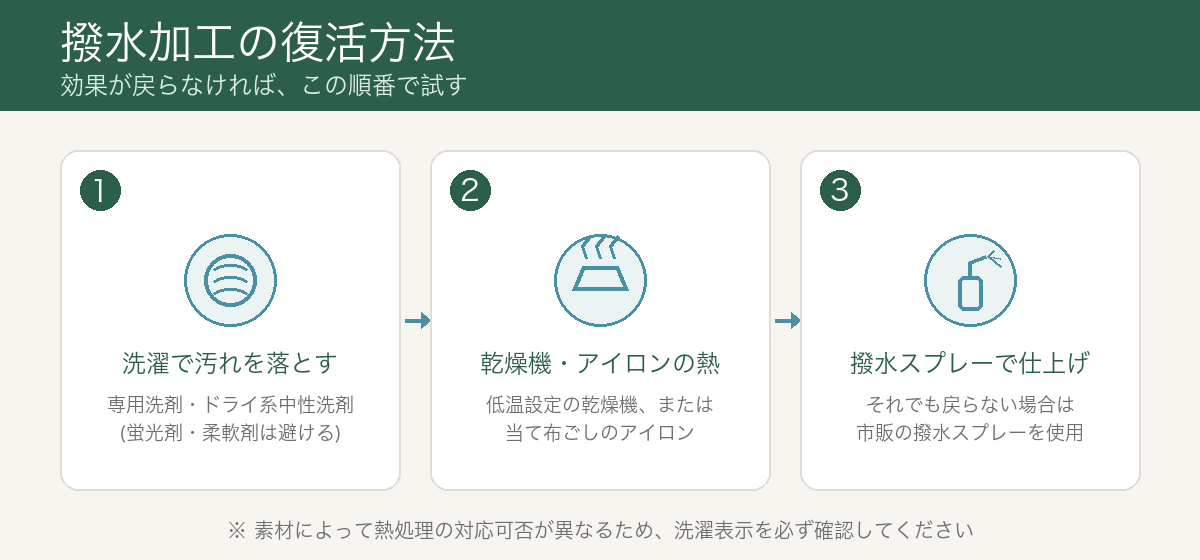
The water-repellent treatment on the surface of rainwear gradually loses its effectiveness with use and washing. When water no longer beads up on the fabric surface but instead spreads out flat, it's a sign that the water-repellent treatment is wearing off.
First, Wash Away Dirt
The main cause of reduced water repellency is the adhesion of sebum and dirt to the fabric surface. Wash using a dedicated rainwear detergent or a neutral detergent for technical fabrics, and avoid regular laundry detergents (containing fluorescent agents or fabric softeners).
Restore Water Repellency with Heat from a Dryer or Iron
Washing alone may restore some water repellency, but applying low heat in a dryer or using an iron with a pressing cloth can help reactivate the water-repellent treatment by evenly spreading its components across the fabric surface (check the care label as compatibility varies by material).
If It Still Doesn't Work, Use a Water-Repellent Spray
If washing and heat treatment do not restore effectiveness, you can regain near-new water repellency by reapplying a commercial water-repellent spray.
Summary
When choosing rainwear, aim for a water pressure resistance of 20,000mm or more and breathability of 10,000g/㎡/24h or more as a guideline. Consider how durability and comfort features change with price range to avoid making a mistake. After purchase, if you feel the water repellency is decreasing, maintenance in the order of washing, heat treatment, and water-repellent spray will allow you to continue using it comfortably for a long time.
For how to put together a full set of equipment, see the Guide to What Beginners Need for Hiking. For hiking boots, also see the Complete Guide to Choosing Hiking Boots, and for backpacks, the Complete Guide to Choosing Hiking Backpacks.